Periodic Table of Type

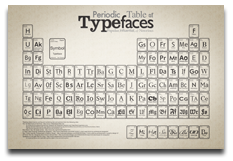
Type is an elemental part of pretty much any design project, so us font junkies rely on tools like sample books, font managers and our own good taste to pick the right typefaces for our layouts. Since we also tend to be creative types, I just love it when I come across a cool new way to do the same old thing — like viewing fonts as a periodic table of the elements.

typetable.png

The incredibly clever team at Squidspot put together the Periodic Table of Typefaces to show off, as they call it, the “popular, influential, and notorious” typefaces all laid out in a slick looking grid that looks like it belongs on the wall in your high school chemistry class.

Yeah, this find lets me blend together my love for typefaces with my interest in science. This is totally über-geek, and now I’m secretly hoping Tom Lehrer has his eye on the Periodic Table of Typefaces, too.

Photoshop CS4: The Missing Manual

When a book like Photoshop CS4: The Missing Manual by Lesa Snider King comes along, you just know I’m chomping at the bit to review it. But through the interesting chain of events that is my life I ended up far more involved in helping out with getting this book out the door than I ever imagined would happen, which means that I’d feel just a wee-tad unethical offering up a review at The Mac Observer, or any of the other places my name crops up, including Design Tools Monthly.

Instead, I’ll give the book an endorsement right here. Hey, this is my blog. I can do whatever I want.

pscs4_cover.gif

When Lesa asked me for some behind the scenes help with her book, I was honored and excited because I enjoy her friendly and approachable writing style, and I’m always glad to do what I can to help out a friend. After spending a little time looking at what she was cranking out I realized that this wasn’t going to be just a good book, it was going to be great.

Long before the book was finished and on press, I was certain that I really needed a copy on my desk — and that’s saying a lot. I reserve the little shelf on my desk for a very short list of books that I always want close at hand. Yes, there’s a copy of Lesa’s book sitting there right now.

If you can get only one Photoshop CS4 book, this is the one to buy. It’s 776 pages packed with everything you need to know about Photoshop along with tons of techniques and tips you should know, but didn’t get why. There’s even extra content and sample files online because you can never learn too much about using Photoshop.

Head over to Lesa’s Web site right now and snag a copy for yourself. If you need some instant gratification, run out to your favorite bookstore tonight. This book is that good. Really.

Target’s Big Ol’ Girl Bullseye

I’ve been mulling over this whole controversy over the Target ad showing a girl on a bullseye for several weeks, and I’m just not seeing the sexual exploitation thing other people are picking up on. Maybe she’s making a snow angel, like many people have suggested, or maybe she’s jumping in the air. But assuming the position for a big old sexing up? I’m just not seeing it.

I totally get and appreciate the importance of protecting people — and not just women or girls — from exploitation. No one deserves to be taken advantage of, and it’s up to all of us to protect those that can’t protect themselves. That’s all just part of being a community.

target_girl.png
Image courtesy of Bennett 4 Senate

For everyone that is in the dark about the Target ad controversy, here’s the deal: Target ran a series of print and billboard ads as part of its winter campaign that depict people performing outdoor wintery acts on the company’s logo (a target) instead of in the snow. Those acts included things like skating, hanging wreaths, and making snow angels.

The problem with the snow angel ad, according to watchdog blogs like AdRants and Shaping Youth, stems from the snow angel girl’s position on the target. Her hips, thighs, and crotch are clearly centered in the target’s bullseye. People that are offended by the image are crying foul because they see the girl’s placement as an intentional sexual reference, as something that denigrates women, and as a message that women are sex objects.

I have to disagree with the watchdoggers on this one. I see a young woman making a snow angel, and I think her positioning on the target was most likely chosen to balance the overall image. That’s it.

I remember my junior high and high school days when certain activist-ish groups wanted to tell me what I could and couldn’t read. They insisted that the Tarzan series shouldn’t be read or even available in libraries. Why? Because Tarzan and Jane were living in the same tree house and they weren’t married.

That’s a connection I wouldn’t have ever made, and it really bothered me when younger kids had that confused look because they didn’t get what the grown ups were all upset about. In the end, they were being exposed to concepts like premarital sex — and sex in general — years before they needed to be thinking beyond the adventures of Tarzan the Ape Man.

The other thing that bothered me was that these groups were looking for sexual references everywhere and in everything. You know, if you go looking for something hard enough and you really want to see it, you probably will… even if it’s not really there.

The Real News in Quark’s DPS Announcement

When Quark announced its Quark Dynamic Publishing Solution this week, the big news was that the company is moving deeper into the enterprise market, right? Wrong. Quark has been on this path for some time, and the whole Quark DPS thing is just another logical extension of that business plan. The real news for me was several paragraphs deep in Quark’s press release where they make a very clear statement about the future of QuarkXPress, the company’s flagship desktop publishing application.

Here’s what Quark CEO Ray Schiavone had to say:

“QuarkXPress is a valuable and widely-used graphic design and page layout tool in its own right, and will play an integral role in Quark DPS. QuarkXPress is and always will be the foundation of our product portfolio and we will continue to invest in it to meet the needs of individual designers and large organizations alike.”

Take a close look at that second sentence, because it’s more important than everything else in the press release. It’s the part where Quark says it isn’t dumping QuarkXPress to focus only on the potentially lucrative enterprise market. It’s the part where Ray makes a public promise to continue developing and supporting QuarkXPress, and that’s a good thing.

Sure, Quark is the company designers love to hate, but that doesn’t change the fact that we need Quark and QuarkXPress to keep Adobe on its toes. As long as we have good competition between QuarkXPress and Adobe InDesign, everyone in the design and publishing community wins. It was Quark’s complacency after stomping PageMaker into the ground that created the “everybody hates Quark but loves XPress” mentality because we didn’t have competition or choices.

OK, to be fair Quark’s former boss Fred Ibrahimi’s total disconnect with customers and general jerk-head attitude drove users away in droves. He did more on his own to drive customers to InDesign than Adobe could have managed with its bottomless pit of resources. Adobe should send Fred a fruit basket to say thanks.

Despite the “screw you, Quark” attitude many designers have today, the truth is that we all need QuarkXPress even if we use InDesign instead. The two applications bring a balance to the universe and give us as consumers choice. The idea of being limited to a single professional page layout application really creeps me out, and I’m glad we have options along with healthy competition.

The truth is that sometimes QuarkXPress is the right tool for the job, and other times it’s Adobe InDesign. You get to decide which you prefer — as it should be.

Rumors that QuarkXPress was going to be phased out have been around for a while now, so it’s good that Quark is finally addressing them.

Just one question for Ray: Why did you wait so long to make a statement? Christ, man, don’t leaving us hanging like that.

I Am Your Plaything. Really.

Not everyone can brag that there is a paper cut out doll version of themselves, and technically there isn’t one of me. But there really kind of is. Through some weird twist in the parallel universe cross-over nexus point thingy, Geek Culture’s Nitrozac created a paper doll me. OK, it’s actually one of the After Y2K characters, but it sure looks like me.

dressupjeff_sw.png

There are a couple different versions of this little digital wonder: A Shockwave-based version and an HTML version suitable for for printing, cutting out, and dressing up on your desk. The printable version had the unexpected side effect of making my nieces think it is totally normal for paper doll versions of their uncle to exist.

jeffdoll.png

The end result, dear reader, is that you can have a little piece of me with you any time you like, all thanks to the deliciously talented Nitrozac.

Dress me up, or make me run around your office in my underpants. Bend me to your will. I am your plaything.